- Web Desk
- Jan 08, 2026
Shehbaz says Pakistan won war against India, now wants peace
-

- Web Desk
- Sep 26, 2025
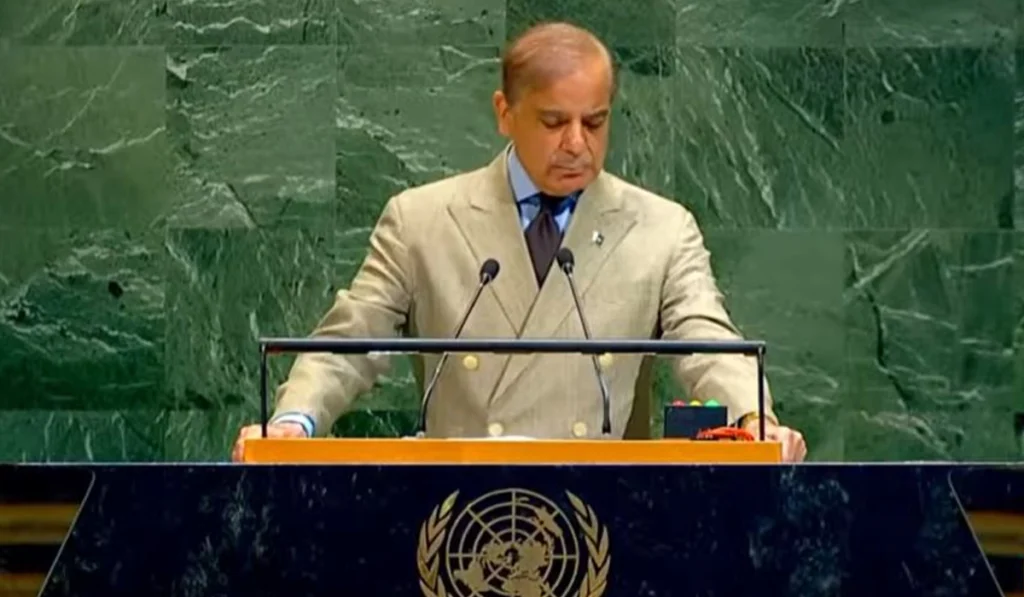
UNITED NATIONS: Making the offer of dialogue to New Delhi, Prime Minister Shehbaz Sharif on Friday said India had sought to extract political gains from a human tragedy — Pahalgam attack — but Pakistan repulsed the Indian aggression and downed seven of its jets in a “decisive response” which “will echo through the annals of history”.
Read more: Unable to revamp air force, India retires Soviet-era ‘flying coffins’
“India sought to extract political gains from a human tragedy by spurning my sincere offer of an independent international investigation into the Pahalgam incident. Instead, it attacked our cities and targeted innocent civilians, violating our territorial integrity and national security.”
TRUMP AND CEASEFIRE
The prime minister, in his address to the UN General Assembly, said Pakistan accepted the ceasefire thanks to the timely intervention of US President Donald Trump as he also thanked China, Turkiye, Saudi Arabia and other nations.
In this connection, he praised Trump for “his bold and visionary leadership” and mentioned the possible destructive consequences if the conflict had turned into full-fledged war.
‘Though in a position of strength, Pakistan agreed to a ceasefire facilitated by President Donald Trump’s bold and visionary leadership,” Shehbaz said.
“We are won the war, and we now seek to win peace in our part of the world” by resolving disputes through diplomacy, Shehbaz said as he extended the offer of composite, comprehensive, and result-oriented dialogue to India.
Read more: Shehbaz in New York for UN General Assembly
The prime minister said, “This is my most sincere and serious offer before this august assembly of world nations. Pakistan stands ready for a composite, comprehensive, and result-oriented dialogue with India on all outstanding issues. South Asia, ladies and gentlemen, needs proactive, not provocative leadership.”
Especially mentioning the “staller leadership” of Field Marshal Asim Munir as well as Chief of Air Staff Zaheer Ahmed Baber Sidhu, the prime minister said Pakistan used the right to self-defence against the Indian aggression.
INDUS WATERS TREATY
In his speech, Shehbaz again made it clear that any violation of the Indus Waters Treaty would be considered an act of war.
“India’s unilateral and illegal attempt to hold the Indus Waters Treaty in abeyance defies the provisions of the treaty itself, as well as the norms of international law.”
“To us, any violation of this treaty represents an act of war.”
At the same time, he assured the Kashmiri people that they would get the right to self-determination one day.
MULTILATERALISM IN A COMPLEX WORLD
Shehbaz went on to say that “our world is more complex today than ever before,” as he advocated the case for multilateralism.
Conflicts are intensifying. International law is being brazenly violated. Humanitarian crises are multiplying. Terrorism remains a potent threat. Disinformation and fake news undermine public trust. Climate change threatens our very survival, and even more so for countries like Pakistan.
“Pakistan will always stand for peace, justice and development for a revitalized United Nations and for cooperative and multilateralism that is fair and inclusive and delivers for all,” said the prime minister.
However, hate speech and hegemonic designs are the biggest threat to achieve goal as they fuel unilateralism.
Therefore, the prime minister also stressed the need for eradicating hate speech and said the Hindutva ideology of Indian ruling party BJP was a grave threat to the whole world.
HECTIC DIPLOMACY
The address comes just a day after US President Donald Trump hosted Shehbaz at the White House where the two leaders discussed a wide range of issues — from trade and investment to counterterrorism and regional security.
Earlier, Shehbaz was among the selected Muslim leaders who met Trump to press for immediate and comprehensive action to resolve the decades-long Palestine issue.
Read more: Muslim leaders for Gaza ceasefire, reconstruction, stabilisation
Friday’s proceedings started with a speech of Israel Prime Minister Netanyahu, but what the world witnessed was a mass walkout of delegations, including all the Muslim nations. Very few countries decided to stay and listen to the Israeli prime minister.
However, they returned to participate in the session as soon as Netanyahu left the rostrum and Shehbaz started to deliver his speech.
AFGHANISTAN AND TERRORISM
Before addressing the UN General Assembly, the prime minister, replying to a question posed by an Indian journalist, said “we are defeating the cross-border terrorism of India”.
He was responding to a question in which the journalist had asked what Pakistan is doing to root out terrorism.
Describing terrorism as a threat to the entire world, Shehbaz said the Afghan interim government must take decisive action against the terrorist groups operating from its soil.
Read more: Pakistan warns of terrorist threat emanating from Afghanistan
In this connection, he named different Indian-sponsored terrorist organisations like BLA, Majeed Brigade and TTP. Afghan soil could not be used against any other country, the prime minister said while stressing that Pakistan has even greater interest in a stable and peaceful Afghanistan.
PALESTINIAN STATE
Shehbaz used the opportunity to again highlight the Israeli atrocities and occupation, and said Pakistan fully supported creation of a Palestinian state.
Meanwhile, he also regretted the global failure to protect the Palestinians amid the ongoing genocide, saying the world failed to call made by Hind Rajab.
Read more: ‘The Voice of Hind Rajab’ gives voice to Palestinians at Venice
The prime minister also discussed the hegemonic designs of Israel and cited the example of Qatar which became the latest country to face Israeli air strikes.
CLIMATE CHANGE
Earlier this week, Shehbaz told world leaders that Pakistan would increase the share of renewables, including the hydropower, to 62 per cent in its energy mix by 2035.
And on Friday, he again discussed the devastating effects of climate change on Pakistan despite negligible contribution in carbon emissions.
However, the prime minister was very critical of the solution that international agencies and financial institutions are suggesting: more borrowing.
That’s why Shehbaz promised to make Pakistan a strong economy to use its onw resources to tackle the challenge, wondering how a country repeatedly witnessing floods and other climate change-induced disasters could afford more loans.
Read more: I’m Nawaz Sharif’s daughter, won’t beg for charity: Maryam
Meanwhile, the prime minister also talked about the steps his government is taking to improve economy including tax reforms and jointly executing the CPEC project with China.
You May Also Like