- Web Desk
- 10 Hours ago
Extremely high deluge in Chenab, Ravi, Sutlej. Flood emergency in Chiniot
-

- Web Desk
- Aug 30, 2025
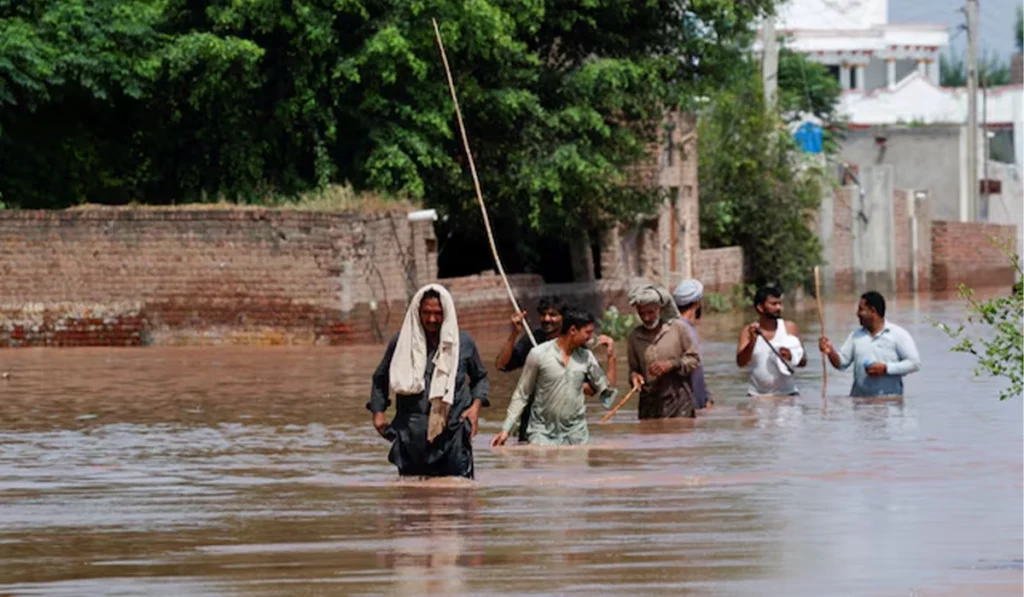
ISLAMABAD: With another monsoon starting to affect upper Pakistan, Chenab and two eastern rivers – Ravi and Sutlej — continued devastating more areas, especially farmland in Punjab, once known as the food basket of entire Subcontinent, on Friday.
And on late Friday night, the district administration imposed flood emergency in Chiniot as the deputy commissioner also ordered closure of all government and private educational institutions on Saturday.
The reason behind the move is the extremely high flood in Chenab which threatening the region after devastating upper parts of Punjab.
Hence, the areas downstream of Qadirabad gained critical importance as the raging flood in the Chenab River moved towards Trimmu.
Earlier, the authorities directed the people living along the rivers to immediately shift to safer locations, as the surging floodwaters have already inundated hundreds of thousands of acres of land from Narowal, Sialkot to Sargodha, Jhang, Sahiwal and Multan.
Meanwhile, Reuters in a report quoted officials as saying that flooding in Pakistan from water flowing downstream from India was made worse by New Delhi’s suspension of a river-sharing treaty and the collapse of the gates on an Indian barrage.
On the other hand, the Provincial Disaster Management Authority (PDMA) on Friday raised the death toll to 28 in Punjab in flood-related incidents.
For the first time in Punjab’s history, flood was being witnessed in three large rivers simultaneously, said PDMA Director General Irfan Ali Kathiya who was explaining the magnitude of unfolding disaster.
THE SHALLOW SUTLEJ IS RISING
Water level is on a decline at Marala, Khanki and Qadirabad, but the surging Chenab River is currently extremely high flood in downstream towards Chiniot and Jhang.
That’s why officials had to blow up a protective dike on Friday to save Jhang city.
Read more: Focus shifts to Trimmu after Qadirabad passes Chenab test
As far as Sutlej is concerned, 327,000 cusecs of waterflow was recorded on Friday afternoon at Ganda Singh Wala — a border village where the river enters Pakistan after passing through the Ferozepur Headworks in India.
However, the waterflow was increasing at an alarming level with the latest reading recorded at over 385,000 cusecs around 9pm.
It means the Sutlej River is in extremely high flood for around two weeks, not only destroying homes, standing crops and livelihoods of thousands of people in Kasur but also in downstream of Ganda Singh Wala.
Sutlej, with a shallow riverbed, passes through eastern districts of Punjab before meeting Chenab at Ucch Sharif in Bahawalpur.
THINGS MADE WORSE
Reuters in its report said the two nations share rivers that originate in India and flow into Pakistan, regulated for more than six decades under the Indus Waters Treaty. That agreement was suspended by India this year, following the Pahalgam attack.
Planning Minister Ahsan Iqbal told Reuters that data on water flows which used to be shared by India under the treaty had not passed to Pakistan quickly enough, or in sufficient detail.
“We could have managed better if we had better information,” said Iqbal. “If the Indus Waters Treaty was in operation, we could have mitigated the impact.”
The middle section of Madhopur barrage, which spans the Ravi River in India, was washed away by surging water, video broadcast by Indian media on Thursday showed.
Pakistani officials said that this damage unleashed an uncontrolled flow across the border, flooding some parts of Lahore on Friday.
When India put the Indus Waters Treaty into abeyance, it stopped the sharing of information between water officials. Instead, warnings were sent this week through India’s embassy in Islamabad.
Read more: India shared flood warning through diplomatic channels, not IWT: FO
Iqbal, whose own constituency of Narowal, near the Indian border, was badly flooded, said that climate change had made the annual monsoon less predictable, making it more vital to share data.
“Climate change is not a bilateral issue,” said Iqbal. “It relates to humanity.”
MORE RAINS, MORE FLOOD
However, things may worsen in the case of Ravi, as the National Disaster Management Authority (NDMA) warned on Friday that the latest monsoon spell coupled with the possibility of India discharging more water from the Thein Dam could worsen the flood situation in the river.
Read more: Fresh monsoon system starts affecting flood-hit Punjab
Earlier on Thursday, the authorities had warned of another possible alarming development — heavy rains in the catchment areas triggering flood in Jhelum.
Read more: NDMA warns of heavy rains in Jhelum catchment areas
The Ravi River has been witnessing a decline in water level from Jassar to Shahdara (Lahore) during the last 12 to 36 hours depending on the location but an increase at Balloki Headworks in Kasur and other downstream areas.
Meanwhile, the waterflow in Ravi on Friday around 5pm at Ravi Siphon was 179,622 cusecs and 176,812 at Shahdara.
However, any release of water the Thein Dam and more downpours in the catchment areas will automatically push the Ravi River again into high or extremely high flood in the region upstream of Lahore.
Ravi enters Pakistan at Kot Naina in Narowal — a district it has already submerged earlier this week.
Meanwhile, there would be another related threat — flash floods in the nullahs and streams originating from Jammu in Occupied Kashmir and Indian Punjab — affecting places like Narowal, Sialkot, Wazirabad and Gujrat.
WHEN THE FIVE RIVERS MEET INDUS
Meanwhile, the NDMA on Friday also warned about the threat posed when the floodwaters from different rivers reach the points where they meet each other.
Read more: Guddu may see 1.2m cusecs flood in worst-case scenario
Further south, the worst-case scenario after Chenab meets the Indus River at Kot Mithan shows that Guddu Barrage could witness a flow of up to 1.2 million cusecs.
The NDMA has estimated that the floodwaters would reach Guddu on September 5 and 6.
You May Also Like