- Web Desk
- Jan 07, 2026
Renowned conservationist and primatologist Jane Goodall dies at 91
-

- Web Desk
- Oct 02, 2025
WEB DESK: Jane Goodall, the pioneering British primatologist whose groundbreaking research transformed the world’s understanding of animal behavior and emotions, has died. She was 91.
According to the Jane Goodall Institute, she passed away of natural causes in California while on a speaking tour in the United States. Her death marks the end of a remarkable life dedicated to science, conservation, and advocacy for the natural world.
Also read: Prince Harry dials in to latest London court media battle
“Dr Goodall’s discoveries as an ethologist revolutionized science,” the institute said in a statement. “She was a tireless advocate for the protection and restoration of our planet.”
Goodall’s career began in 1960, when the 26-year-old, who had no formal scientific training, traveled to Tanzania’s Gombe Stream Chimpanzee Reserve at the invitation of famed anthropologist Dr Louis Leakey. What began as a simple observation project would evolve into one of the most significant scientific studies of the 20th century.
Her fieldwork revealed astonishing insights into chimpanzees. She documented their use of tools, their complex social structures, and their capacity for emotions like joy, grief, and compassion. These findings challenged long-held assumptions about the uniqueness of humans and redefined the relationship between people and the animal kingdom.
Goodall’s work was not only scientifically revolutionary, it was also socially groundbreaking. At a time when women were largely excluded from field science, she broke through barriers with determination and grace. Her presence in the forests of Gombe, naming and bonding with individual chimpanzees rather than numbering them, sparked both controversy and admiration in academic circles.
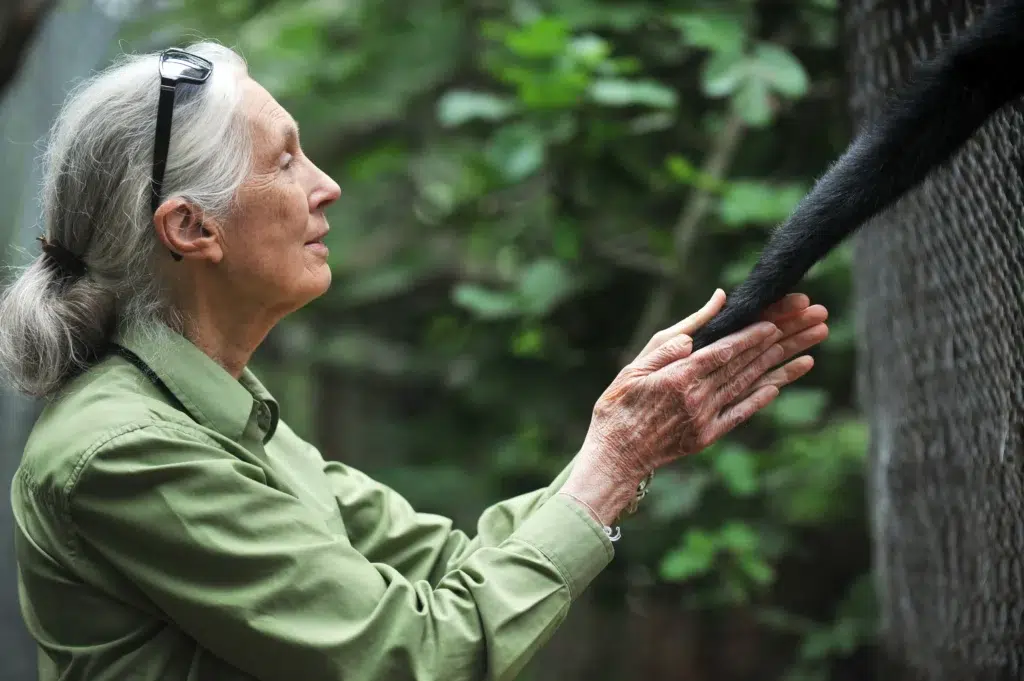
She famously formed a bond with an older chimp she called David Greybeard, who would become a central figure in her early studies. Reflecting on their first interaction, Goodall recalled how he gently squeezed her hand, “a gesture of reassurance,” she explained, that spoke to a shared language beyond words.
Born in London in 1934, Goodall’s fascination with animals began early. At just four years old, she spent hours quietly watching a hen lay an egg, much to the alarm of her mother, who had frantically searched for her. That early patience and curiosity would come to define her scientific career.
Goodall pursued her doctorate in ethology at Cambridge University, despite never having earned an undergraduate degree, and in 1965 helped establish the Gombe Stream Research Center, which remains the longest-running continuous study of any animal population in the wild.
Over the decades, Goodall’s mission evolved. In 1986, after attending a conference on chimpanzee conservation, she shifted her focus from pure science to global environmental advocacy. She founded the Jane Goodall Institute in 1977, an organisation that now operates worldwide to protect wildlife and empower communities.
She also launched the youth program “Roots & Shoots,” encouraging young people to take action on behalf of animals, people, and the environment. Even into her 80s, Goodall traveled the globe, sometimes up to 300 days a year, meeting with world leaders, students, and scientists to promote conservation and sustainability.
In recognition of her life’s work, Goodall received numerous honors, including being named a Dame of the British Empire in 2004, a United Nations Messenger of Peace in 2002, and the US Presidential Medal of Freedom in 2025.
Her legacy, she once said, was not just about science, but about hope. “I want my legacy to be giving young people hope and a sense of empowerment,” she told CNN.
The United Nations, in a tribute posted on social media, described Goodall as someone who “worked tirelessly for our planet and all its inhabitants, leaving an extraordinary legacy for humanity and nature.”
Also read: Jonathan Anderson debuts Dior womenswear on Paris runway
From a young girl dreaming of life in the African forests, to a scientist who changed the way the world sees its fellow creatures, Jane Goodall’s journey was a testament to the power of passion, perseverance, and compassion.
She leaves behind not only a richer understanding of the natural world, but also generations of scientists, conservationists, and young people inspired to protect it.
You May Also Like