- Aasiya Niaz
- Yesterday
UN mandate for Gaza stabilisation force still in works: Turkiye
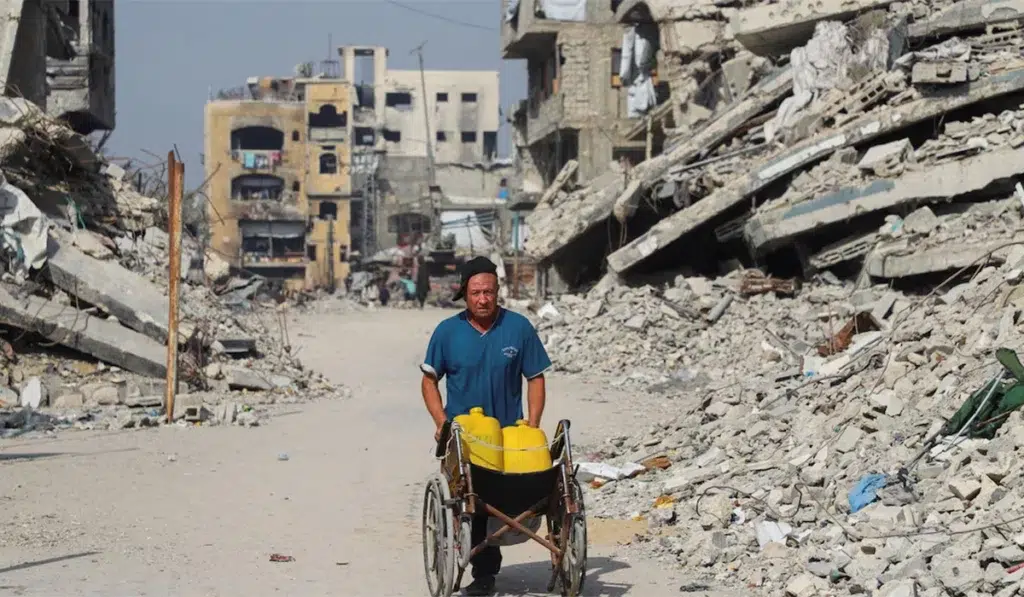
ISTANBUL: Countries are still working on a planned UN mandate for a temporary international stabilisation force in Gaza as part of a US-brokered ceasefire deal, and they will decide whether to send soldiers based on this, Turkish Foreign Minister Hakan Fidan said on Monday.
The remarks came as Turkiye and six of its top Muslim allies said after talks in Istanbul that Gaza’s future must be Palestinian-led and avoid any new system of tutelage.
Read more: Turkiye to host meeting on Gaza ceasefire, stability force
“Our principle is that Palestinians should govern the Palestinians and ensure their own security, the international community should support this in the best possible way — diplomatically, institutionally and economically,” Fidan told a press conference.
“Nobody wants to see a new system of tutelage emerge,” he told a news conference.
On the other hand, Ministry of Foreign Affairs in Islamabad though a post shared on X said Deputy Prime Minister Ishaq Dar, who is also the country’s foreign minister, along with his counterparts from other Arab-Islamic countries “deliberated on the way forward for a lasting ceasefire and sustainable peace in Gaza”.
“The leaders jointly called for urgent humanitarian aid for the Palestinians, condemned Israeli ceasefire violations, demanded Israel’s withdrawal from the Occupied Palestinian Territory and emphasized the rebuilding of Gaza,” it added.
In this connection, the ministry said, “Pakistan reaffirmed its principled stance for the establishment of an independent, viable and contiguous State of Palestine based on pre-1967 borders.”
PALESTINIANS SHOULD GOVERN PALESTINE
Turkiye wants to see a post-war framework for Gaza in which “Palestinians ensure Palestine’s governance and security,” he said, after a meeting in Istanbul involving Qatar, Saudi Arabia, the United Arab Emirates, Jordan, Pakistan, Indonesia and Turkiye.
Read more: Dar in Istanbul as Muslim nations discuss Gaza reconstruction
The term “temporary international stabilisation force” is used for a military or security deployment with a specific, usually short-term, mandate to maintain peace in a conflict or post-conflict zone. And these forces can operate under a UN mandate or be deployed by regional organizations or coalitions of states.
A temporary international stabilisation force is also envisaged under the Gaza peace plan of US President Donald Trump as Hamas is to be disarmed while revitalising the Palestinian Authority.
Read more: Hamas, other groups agree to hand Gaza to technocrat committee
Fidan told the press conference there were some issues in fully implementing the agreement because Israel was regularly violating it, adding Israel must fulfil its duty to allow in sufficient aid.
He also expressed hope that reconciliation efforts between Hamas and the rival West Bank-based Palestinian Authority, “will bear fruit as soon as possible,” saying inter-Palestinian unity would “strengthen Palestine’s representation in the international community”.
SEEKING ‘DEFINITION AND LEGITIMACY’
NATO member Turkiye has been one of the most vocal critics of Israel’s two-year assault on Gaza, calling it a genocide, which Israel denies.
With US urging, it has emerged as a key player in ceasefire efforts, helping to mediate the deal and voicing a desire to join task forces to monitor its implementation.
However, Israel has voiced its opposition to such Turkish involvement.
Asked about what role Turkiye wanted to play, Fidan said countries are seeking to give a definition and “legitimacy” to the mission.
“They will decide, based on the contents of this definition, whether to send soldiers or not,” he said.
The Gaza truce, which left issues such as the disarmament of Hamas and a timeline for Israel’s withdrawal from Gaza unresolved, has been tested by periodic violence since coming into force on October 10.
Fidan said Turkiye wanted to see Palestinians ensure their own security and manage their own governance after the war, but that there were other steps that needed to be taken first.
You May Also Like