- Web Desk
- 35 Minutes ago
Sir Mark Tully: BBC journalist who reported India’s most turbulent moments dies aged 90
-

- Aasiya Niaz
- 2 Hours ago
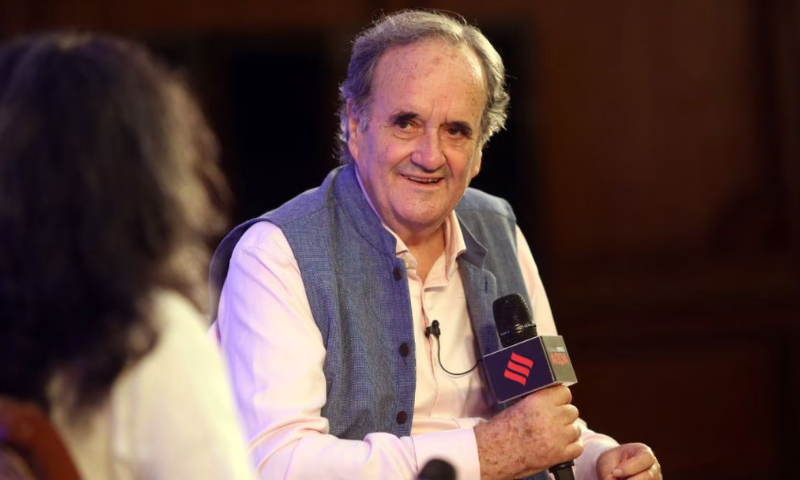
Sir Mark Tully, the veteran broadcaster long regarded as the BBC’s “voice of India”, has died at the age of 90.
For decades, Tully was one of the most recognisable foreign correspondents in British broadcasting, reporting from India through war, famine, political upheaval and moments of profound national trauma. His calm authority and deep familiarity with the country set him apart from many of his contemporaries.
Tully covered some of the most consequential events in modern Indian history, including the Bhopal gas disaster, political assassinations and the Indian army’s storming of the Golden Temple in Amritsar. In 1992, he narrowly escaped serious harm while reporting from Ayodhya as a Hindu mob demolished the Babri mosque, an event that triggered widespread religious violence.
During the unrest, Tully was threatened by members of the crowd who chanted “Death to Mark Tully”. He was locked in a room for several hours before being rescued by a local official and a Hindu priest. He later described the mosque’s destruction as the gravest setback to India’s secular foundations since independence in 1947.
The BBC’s interim chief executive for news, Jonathan Munro, paid tribute to Tully, describing him as one of the pioneers of foreign correspondence who opened India to the world.
“As bureau chief in Delhi, he brought the vibrancy and diversity of India to audiences in the UK and globally,” Munro said. “Widely respected in both countries, he will be greatly missed.”
Born in Calcutta, now Kolkata, in 1935, Tully was a child of the British Raj. Although he was educated in Britain, he regarded India as his home for most of his life, living there for more than three quarters of his lifetime.
Unlike many foreign correspondents, Tully became fluent in Hindi, earning him widespread respect and the affectionate title “Tully sahib” among Indians. His language skills and cultural sensitivity gave him rare access to politicians, activists and ordinary citizens alike.
He joined the BBC in India in 1965, initially in an administrative role, before moving into journalism. Over time, he became head of the BBC’s Delhi bureau, overseeing coverage not only of India but of South Asia more broadly, including the birth of Bangladesh, political turmoil in Pakistan, conflict in Sri Lanka and the Soviet invasion of Afghanistan.
Tully was expelled from India in 1975 after prime minister Indira Gandhi imposed a state of emergency, but he returned 18 months later and continued reporting from Delhi for decades.
In the early 1990s, he publicly criticised the BBC’s leadership, accusing senior management of running the organisation through fear. He resigned from the corporation in 1994 but continued contributing to BBC programmes, including Radio 4’s Something Understood, where he explored faith and spirituality.
India honoured him with two of its highest civilian awards, the Padma Shri and Padma Bhushan, a rare distinction for a foreign national. Britain knighted him in 2002 for services to broadcasting and journalism, an honour he described as belonging as much to India as to himself.
Sir Mark Tully spent his later years writing books and essays on Indian society and politics, living quietly in south Delhi. Although he retained his British citizenship, he also became an Overseas Citizen of India, saying it allowed him to belong to the two countries he considered home.
You May Also Like