- Web Desk
- 2 Hours ago
Nihilist penguin, Trump and Greenland: how a meme, AI Imagery and US policy collided
-

- Web Desk
- 2 Hours ago
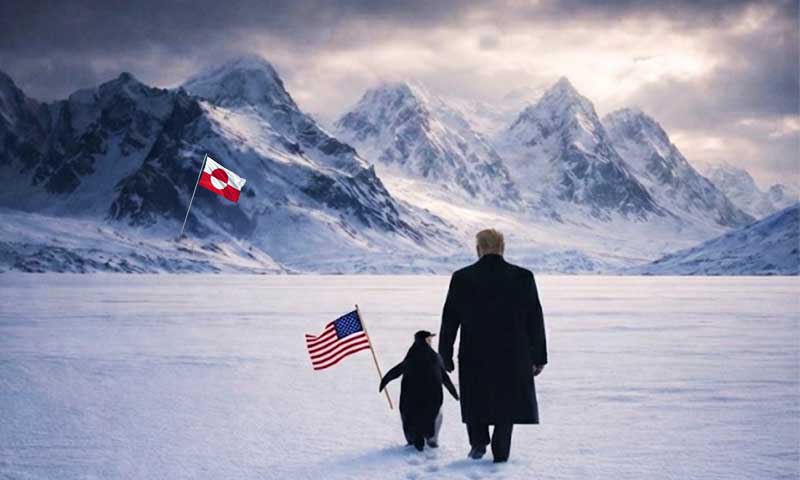
WEB DESK: An AI-generated image posted by the White House has placed Washington at the centre of an unusual controversy, blending internet meme culture, artificial intelligence and President Donald Trump’s revived push to acquire Greenland. The post, featuring Trump alongside a penguin, has drawn criticism for factual inaccuracies, raised questions about official use of AI-generated content, and reignited debate over US intentions in the Arctic and of course the nihilist penguin meme.
The image, shared Friday on the White House’s official X account, shows President Trump walking toward Greenland’s flag while holding the wing of a penguin clutching an American flag. The caption, “Embrace the penguin,” offered no further context. While seemingly whimsical, the post quickly became a lightning rod for mockery, criticism and geopolitical commentary, particularly as it coincided with Trump’s renewed public remarks about Greenland.
Washington’s Message and the Greenland Push
The timing of the post was widely noted in Washington policy circles. Only days earlier, President Trump had reiterated at the World Economic Forum (WEF) in Davos that the United States had a “framework” for acquiring Greenland, once again framing the autonomous Danish territory as vital to US national security.
Trump first floated the idea during his initial term in office, prompting strong rebukes from Denmark and Greenland’s leadership. Though the proposal never advanced formally, it has resurfaced periodically amid growing strategic competition in the Arctic, where melting ice has opened new shipping routes and access to rare earth minerals.
Officials have not explicitly linked the AI image to Greenland policy, but analysts said its symbolism was difficult to ignore. “This was not a random post,” said one Washington-based analyst. “It lands in the middle of a deliberate effort to keep Greenland in the political conversation.”
However, instead of reinforcing the administration’s message, the image has drawn attention to a basic geographic error that critics say undermines credibility.
The geographic error that sparked backlash
Almost immediately after the image was posted, users pointed out that penguins do not live in Greenland. With the exception of the Galápagos penguin, all penguin species inhabit the Southern Hemisphere, while Greenland lies in the Arctic far north.
Greenland’s actual wildlife includes polar bears, seals, walruses and Arctic foxes, not penguins, which are commonly associated with Antarctica.
The oversight became a focal point for critics questioning the administration’s attention to detail. Social media users, academics and political commentators alike seized on the error as emblematic of what they described as a casual approach to facts in official communications.
The account @patriottakes wrote: “Perhaps you shouldn’t have dismantled the Department of Education so quickly,” while conservative commentator Erick Erickson joked that the post suggested the United States was preparing to invade Antarctica.
International Reaction and Danish Pushback
The response was not limited to domestic critics. International figures weighed in sharply, particularly from countries with direct stakes in Arctic governance.
Former Canadian defence minister Jason Kenney said the incident reflected poorly on US leadership, writing that Trump and his staff appeared to be confusing Greenland, Iceland and Antarctica in rapid succession. “The most powerful nation on Earth being run like a clown show,” he wrote.
In Denmark, which oversees Greenland’s foreign and defence policy, the reaction was even more pointed. Rasmus Jarlov, a conservative member of the Danish parliament, said the image underscored the absurdity of Trump’s territorial ambitions. “The message from the White House is clear,” he wrote. “Trump belongs in Greenland as much as penguins do.”
The Danish government has repeatedly stressed that Greenland is not for sale, and Greenlandic officials have emphasised their right to self-determination.
Enter the Nihilist Penguin
What further amplified the reaction was the image’s unexpected overlap with a viral internet phenomenon known as the “Nihilist Penguin.”
The meme originates from Encounters at the End of the World, a 2007 documentary by German filmmaker Werner Herzog. In one scene, Herzog describes a lone Adélie penguin that inexplicably abandons its colony in Antarctica and begins walking inland toward distant mountains, a journey that leads to certain death.
Herzog narrates the moment as an act without reason or hope, describing the penguin as having “no future” once it turns away from the sea. Over time, the clip became a symbol of existential absurdity online.
In early 2026, the penguin resurfaced across TikTok, X and Instagram, often paired with a slowed, organ-style remix of Gigi D’Agostino’s L’Amour Toujours. The bird’s solitary march came to represent burnout, alienation and quiet despair, a figure walking away from everything without explanation.
For many users, the White House’s penguin imagery appeared to unintentionally echo this nihilistic symbolism.
Meme Culture Meets State Power
Media analysts say the collision of meme culture and official state communication is increasingly common, but fraught with risk.
“The administration is clearly trying to appear culturally fluent and digitally savvy,” said a media researcher who studies political communication. “But memes are not neutral. They come with histories and meanings that can easily backfire.”
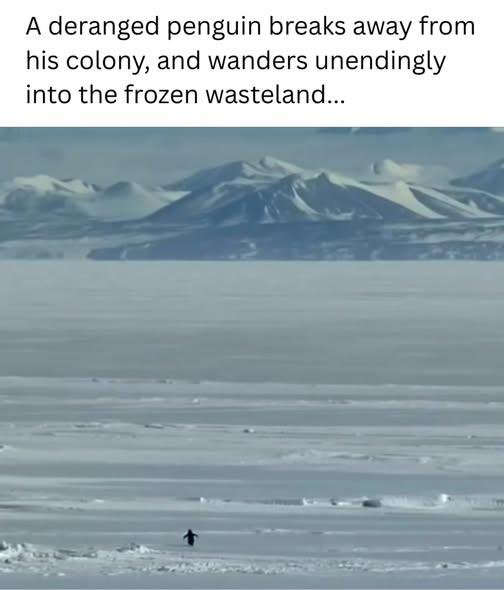
In this case, critics argued that pairing Trump’s Greenland ambitions with an animal symbolising existential futility was unintentionally revealing.
Online, users recast the image as commentary on US foreign policy, with captions suggesting that Washington, like Herzog’s penguin, was marching confidently toward a cliff.
The Reality of US–Greenland Relations
Lost amid the controversy is the substantive reality of US involvement in Greenland. The United States already maintains a significant military presence on the island through Thule Air Base, established under a 1951 defence agreement with Denmark. The base plays a key role in missile warning systems and Arctic surveillance.
Experts note that this existing arrangement already grants Washington extensive strategic access, complicating arguments that outright ownership of the territory is necessary for national security.
“The irony is that the US already has what it needs in Greenland,” said an Arctic policy expert. “The debate is more about symbolism and power projection than actual defence requirements.”
AI, Accuracy and Credibility
The White House has not issued a correction or explanation regarding the image, nor has it clarified whether human oversight was involved in generating or approving the post.
The episode has renewed concerns about the use of AI-generated content in official government communications, particularly when such material can spread globally within minutes.
Critics argue that symbolic missteps, especially those involving easily verifiable facts, risk overshadowing serious policy discussions and damaging credibility abroad.
As the image continues to circulate, it serves as a reminder that in the digital age, even a single AI-generated picture can shape narratives far beyond its creators’ intentions.
For now, a penguin once framed by Werner Herzog as a creature walking toward nothingness has found itself at the centre of US foreign policy debate, a surreal intersection of memes, machines and modern power politics.
You May Also Like