- Web Desk
- 27 Minutes ago
India cautious over Trump-led ‘Board of Peace’ amid Kashmir concerns
-

- Web Desk
- 1 Hour ago
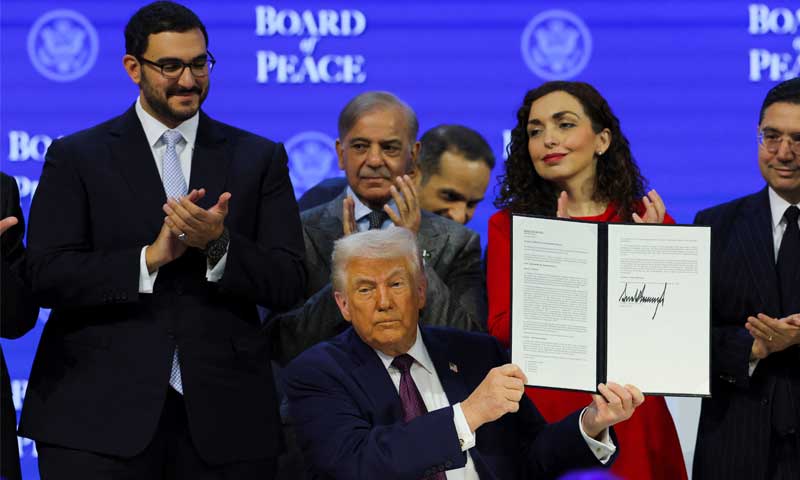
WEB DESK: India has not formally joined US President Donald Trump’s newly announced ‘Board of Peace’, despite receiving an invitation, with analysts and sections of the Indian media suggesting that concerns over Kashmir may be shaping New Delhi’s hesitation.
India was notably absent from the signing ceremony held on the sidelines of the World Economic Forum in Davos, where around 20 leaders, including President Trump and Prime Minister Shehbaz Sharif, endorsed the charter establishing the body.
President Trump has described the initiative as a platform designed to make the Gaza ceasefire between Israel and Hamas permanent and to supervise the formation of an interim administration in the Palestinian territory. Speaking at the event, he said the initiative could eventually be expanded to address conflicts beyond Gaza and positioned it as a potential alternative to the United Nations.
In India, however, the proposal has triggered debate. Commentators have raised concerns that participation in the board could invite external involvement in long-standing disputes, particularly Kashmir. Trump has previously offered to mediate between India and Pakistan on the issue, including after heightened tensions between the two countries in May 2025, offers that New Delhi has consistently rejected.
According to a BBC Hindi report, the timing of the initiative has also drawn scrutiny, as the United States has stepped back from several UN bodies, prompting questions over whether the Board of Peace is intended to sideline existing multilateral institutions. Critics have further argued that the mechanism could reinforce a US-centric global order.
An editorial in The Hindu described Pakistan’s decision to join the board as a “signal of concern” for India, noting Trump’s tendency to portray himself as an international peacemaker. The paper warned that if Kashmir were brought under the board’s remit, India could find it difficult to resist international involvement, including the possible deployment of peacekeeping forces.
Former Indian ambassador to the United Nations Syed Akbaruddin has pointed out that the UN Security Council resolution underpinning the Gaza framework limits its mandate to December 31, 2027, and requires regular reporting to the council. He contrasted this with Trump’s proposed board, which, he argued, lacks a defined timeline and could be applied to other conflict zones.
Akbaruddin added that some UN officials have indicated the model could be extended beyond Gaza, raising further concerns about its scope.
Ranjit Roy, a former Indian envoy to Nepal and Vietnam, said the decision posed a difficult choice for New Delhi. Speaking to BBC Hindi, he said joining the board carried significant risks, particularly given Trump’s leadership of the initiative.
He questioned whether all participating countries would enjoy equal standing within the body, noting that while the UN General Assembly operates on a one-country-one-vote principle, the evolving nature of the Peace Board could dilute such parity. Roy also warned that although the UN-backed arrangement was initially confined to Gaza, changes to its structure could allow it to expand its reach.
The Hindu further suggested that broader diplomatic considerations may also be at play, including strains in US-India relations and the sensitivity of ongoing trade discussions. The editorial argued that outright rejection of Trump’s proposal could provoke a negative response from Washington, citing past instances where leaders faced consequences after publicly opposing the US president.
You May Also Like