
- Web Desk
- 30 Minutes ago
Gul Plaza tragedy: War of words b/w PPP’s Sharjeel Memon and MQM-P’s Farooq Sattar continues
-

- Web Desk
- 1 Hour ago
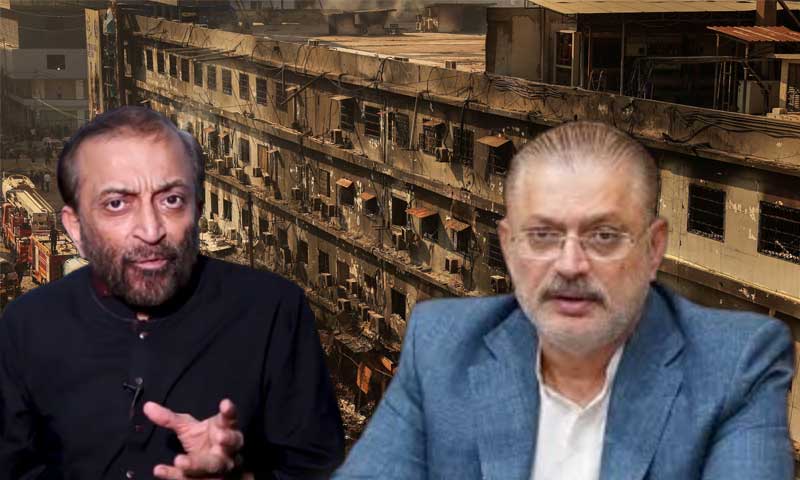
WEB DESK: The deadly Gul Plaza fire has triggered a sharp political exchange between Sindh Senior Minister Sharjeel Inam Memon and Muttahida Qaumi Movement-Pakistan (MQM-P) leader Farooq Sattar, as both sides traded accusations over responsibility for what has been described as one of Karachi’s gravest urban disasters in recent years.
Addressing the media, Sharjeel Inam Memon squarely blamed the roots of the tragedy on decades-old policies, alleging that the culture of unsafe and illegal construction in Karachi flourished during MQM’s time in power. “No matter how fluent and eloquent Farooq Sattar’s Urdu may be, he cannot distort reality,” Memon said. “The foundation of illegal constructions in Karachi was laid during the MQM era, when building violations were regularised and granted legal protection.”
He stressed that the Gul Plaza incident was not the result of a single day’s negligence. “This tragedy is the logical outcome of wrong decisions and administrative failures spanning decades,” the senior minister said. “Those who laid the groundwork for these flawed policies cannot escape accountability today.”
Memon added that the public was asking hard questions about who should be held responsible. “If the foundation itself was wrong, then those who legitimised illegal constructions are morally and politically answerable,” he said, while insisting that the Sindh government was committed to fixing long-standing structural and regulatory failures.
Responding to the accusations, MQM leader Farooq Sattar rejected the blame and accused the Sindh government of deflecting responsibility. “The Gul Plaza incident is a tragedy of a very serious nature, and we have never called it a conspiracy,” Sattar said. “We have not indulged in speculation. What we are doing is asking legitimate questions that reflect the anger and grief of the people.”
Sattar questioned the response time of senior provincial and city officials following the incident. “Where were the ministers when the tragedy unfolded?” he asked. “Karachi Mayor Murtaza Wahab reached the site 23 hours later. What was he doing in Islamabad at the time? Even the Sindh chief minister arrived at the scene after a delay of 22 hours.”
He alleged that the government was providing evasive answers instead of addressing core issues. “Questions are being asked, but irrelevant responses are being given. The chief minister is misleading the public on these concerns,” Sattar claimed.
Highlighting the scale of the disaster, the MQM leader said that more than 100 people had lost their lives, while several others remained missing. “Who will take responsibility for supporting the families of the missing and the deceased?” he asked. “The Sindh government and the Karachi Metropolitan Corporation must clearly outline their plan of action.”
Sattar also criticised the province’s fire safety preparedness, saying that despite controlling Sindh’s resources since 2008, the government had failed to strengthen emergency infrastructure. “How many fire tenders were added during these years?” he asked, claiming that nearly 200 buildings in Karachi lack proper fire safety arrangements.
Calling for an independent probe, Sattar announced that MQM was demanding the formation of a judicial commission to investigate the Gul Plaza tragedy. He said the commission should include representatives from the National Accountability Bureau (NAB), Federal Investigation Agency (FIA), Provincial Disaster Management Authority (PDMA), and the Pakistan Engineering Council.
As rescue, identification, and investigation efforts continue, the political blame game underscores broader concerns about governance, urban safety, and accountability in Pakistan’s largest city, where the Gul Plaza disaster has once again exposed deep-seated structural and administrative failures.
You May Also Like